


“news values", elements of "newsworthyness"
#jronews
Introductory paragraph
The following section explains key “news values” that journalists use to decide which events become news stories. These values—such as conflict, proximity, relevance, timeliness, prominence, human interest, and novelty—help determine how interesting, important, and engaging a story will be for a particular audience. Understanding these elements gives readers and students a clearer sense of why some events receive extensive coverage while others receive little or none.
Conflict
Conflict is about clashes, disagreements, or tension between people, groups, or forces.
Stories about elections, strikes, lawsuits, wars, protests, or even intense sports rivalries all score high on conflict because audiences are naturally drawn to struggle and drama.

Proximity
Proximity is how close the event is to the audience, usually geographically but sometimes culturally or socially. A minor fire in your city is often more newsworthy for local media than a bigger fire in another country, because people care more about what feels “nearby.”

Relevance / Impact / Consequence
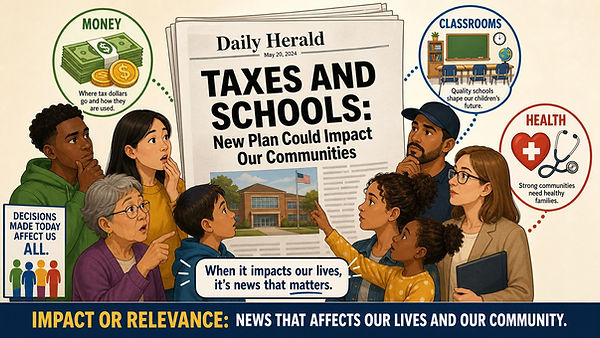
Relevance (often labelled impact, significance, or consequence) asks, “How much does this matter to this audience?” A story about changes to tax law, school policies, or health regulations has high impact because it affects many people’s lives directly, even if there’s no dramatic conflict.
Timeliness
Timeliness is how recent or “of the moment” the event is. News favors what just happened or is happening now; an event from last year usually only returns to the news if there’s a new development or anniversary hook.

Prominence
Prominence is about who is involved: the more well‑known the people or institutions, the more newsworthy the story. A routine medical checkup for a celebrity can make news when the same event for an ordinary person would not, simply because audiences already recognize and follow prominent figures.

Human Interest
Human interest focuses on emotional appeal and personal stories rather than strictly on policy or hard facts. Profiles of individuals overcoming hardship, acts of kindness, or unusual life journeys may be news mainly because they touch empathy, curiosity, or inspiration.

Application Video:
extended warranty letters
Do the assignment....
--
Warranty Letter Assignment
American police departments have a media relations problem, and that problem is not limited to the various accusations and successions of distrust and conflict associated with police brutality and racial bias. Their problem goes to the heart of wearing a uniform –representative of a section of the government that can exercise a significant amount of power of the citizens—while engaging in public rhetoric of a subjective nature. For military service members who fall under the umbrella of the Department of Defense, wearing a uniform while publicly and dabbling in politics and opinions is forbidden. However, at the recent 2016 Republican National Convention in Cleveland in July, Milwaukee County Sheriff David Clarke recently stood affront a crowd of obviously political partisan individuals, wearing his uniform in full dress, and provided a clear “appearance” (Defense, 2008, pp 4.1.1.9.) of affiliating his governmental organization with a political party, its political candidates, and its political views (Massie, 2016). Similarly, in relation to the same party convention, Cleveland Police Chief Calvin D. Williams uttered words that appeared to question the laws of his state (Holley, 2016). which is usually best left to lawmakers and politicians.
According to Department of Defense Document 1344.10, military service members would not be allowed to conduct themselves in that manner publicly. Police officers and their organizations blur the line between civilian and non-civilian, and as these government officials mingle with politics through their media efforts are not doing anything to change the problem that police departments across the country are having with their public image. This study is to serve as a consult to police departments to better effect their image by mirroring the public affairs doctrine of the DoD and its military branches, who orient their media relations guidelines in sync with the Public Relations Society of America that pledges to “conduct [themselves] professionally, with truth, accuracy, fairness, and responsibility to the public” (PRSA, 2016).