


Biblical Ethics and Project 2025: A Structural Contradiction
Student JROSpace
Dr. Johnson
Course Date: infinity & beyond

Introduction
Across both the Old and New Testaments, the Bible presents a consistent moral framework: protect the poor, restrain the powerful, and judge societies by how they treat the vulnerable. This ethic appears in the Law, the Prophets, the teachings of Jesus, and the practices of the early church. In contrast, the policy agenda advanced by the Heritage Foundation’s Project 2025—and exemplified through the actions of former Office of Management and Budget (OMB) Director Russell Vought—promotes structural changes that reduce protections for the poor while expanding advantages for the wealthy and politically powerful. This paper examines the contradiction between biblical ethics and Project 2025, using Vought’s documented attempts to cut veterans’ healthcare while quietly redirecting taxpayer funds to a luxury ballroom project as a case study illustrating the broader moral inversion.

Biblical Mandates Concerning the Poor
The Bible repeatedly commands care for the poor, the sick, the foreigner, and the oppressed. In the Old Testament, God instructs Israel to build structural protections into its economy. Leviticus commands landowners to leave portions of their harvest for the poor and the foreigner: “Thou shalt not wholly reap the corners of thy field… thou shalt leave them for the poor and stranger” (Lev. 19.9–10). This is not charity but mandated economic justice.
The prophets condemn societies that neglect the vulnerable. Psalm 82 commands rulers to “defend the poor and fatherless: do justice to the afflicted and needy” (Ps. 82.3). Proverbs teaches that “he that hath pity upon the poor lendeth unto the Lord” (Prov. 19.17), equating care for the poor with devotion to God.

. In Luke’s Sermon on the Plain, he declares,
“Blessed be ye poor: for yours is the kingdom of God” (Luke 6.20), while warning, “Woe unto you that are rich! for ye have received your consolation” (Luke 6.24). In Matthew 25, Jesus describes the final judgment as hinging on care for the hungry, sick, imprisoned, and marginalized: “Inasmuch as ye have done it unto one of the least of these… ye have done it unto me” (Matt. 25.40).

The early church practiced voluntary redistribution: “Neither was there any among them that lacked… distribution was made unto every man according as he had need” (Acts 4.34–35). Across Scripture, the pattern is clear: lift the poor, restrain the rich, protect the vulnerable, and judge neglect.
Project 2025 and Its Impact on the Poor
Project 2025, published by the Heritage Foundation, outlines a sweeping restructuring of the federal government. Its proposals include reducing or eliminating programs such as SNAP, Medicaid expansion, housing assistance, and disability benefits.
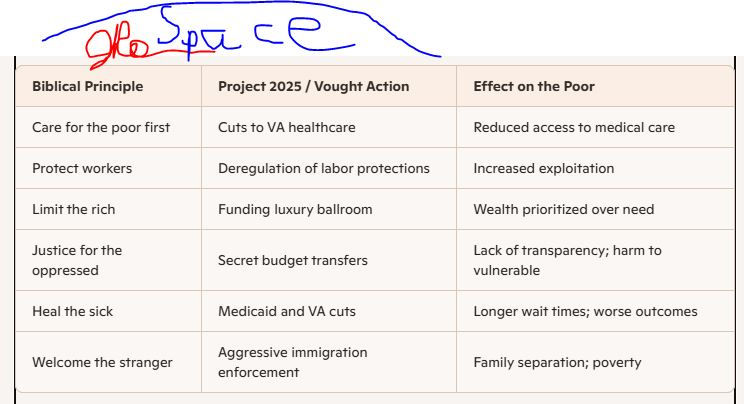
These cuts disproportionately harm low‑income families, elderly Americans, disabled individuals, and rural communities.
The plan also calls for deregulating labor protections, weakening the National Labor Relations Board, and reducing OSHA enforcement. These changes benefit corporations while exposing workers—especially low‑income workers—to exploitation. The Bible explicitly condemns such exploitation: “Thou shalt not oppress an hired servant that is poor and needy” (Deut. 24.14).
Project 2025 further proposes gutting the Consumer Financial Protection Bureau (CFPB), which protects Americans from predatory lending. Without these protections, low‑income families face higher interest rates, debt traps, and financial abuse. This contradicts biblical Jubilee laws, which forbid predatory lending and require periodic debt release (Lev. 25).

Other Project 2025 proposals include privatizing public education, expanding aggressive immigration enforcement, reducing healthcare access through Medicaid cuts, and increasing federal policing powers. Each of these policies disproportionately harms the poor, contradicting biblical commands to welcome the stranger, heal the sick, and defend the oppressed.
Case Study: Russell Vought’s VA Healthcare Cuts and Secret Ballroom Funding
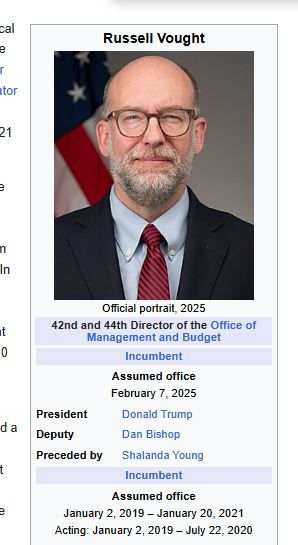
The contradiction between biblical ethics and Project 2025 becomes especially clear in the documented actions of Russell Vought, former Director of the Office of Management and Budget and a principal architect of Project 2025.
Cuts to Veterans’ Healthcare
During his tenure, Vought advanced budgets that proposed cuts to veterans’ medical services, caregiver support programs, and housing assistance. Major veterans’ organizations—including the Disabled American Veterans (DAV), Veterans of Foreign Wars (VFW), and Iraq and Afghanistan Veterans of America (IAVA)—publicly warned that these cuts would increase wait times, reduce access to care, and harm disabled and rural veterans. News reporting from outlets such as The Washington Post and Military Times documented these proposed reductions and the opposition they generated.
Veterans—many of whom are low‑income, disabled, or elderly—would have been disproportionately harmed. Cutting medical care for wounded veterans contradicts biblical commands to “defend the poor and needy” (Ps. 82.3) and Jesus’ mandate to heal the sick (Matt. 25.36).
Secret Funding of the Taxpayer‑Paid Ballroom
While publicly advocating cuts to veterans’ healthcare, Vought quietly approved the redirection of taxpayer funds to support construction of a luxury White House ballroom project. Congress had explicitly rejected funding for the ballroom, and public statements claimed no taxpayer money would be used.
However, investigative reporting from outlets including The New York Times and ProPublica documented internal budget transfers from Secret Service and White House Military Office accounts to sustain the project.
Contractor invoices and internal budget documents confirmed that taxpayer funds were used despite congressional rejection. This diversion of funds away from national security and veterans’ support functions toward a luxury construction project represents a stark moral inversion: prioritizing wealth and prestige over the needs of wounded veterans.
Jesus warns against such inversion:
“Ye cannot serve God and mammon” (Matt. 6.24).
Funding a vanity project while cutting care for wounded veterans exemplifies the “woe unto you that are rich” warning (Luke 6.24).
Biblical Ethics vs. Project 2025: Structural Contradiction
The Bible’s ethic is protective, distributive, and compassionate. Project 2025’s ethic is hierarchical, extractive, and punitive. The case study of Russell Vought illustrates this contradiction vividly.
The contradiction is not merely rhetorical—it is structural. Biblical ethics demand protection of the vulnerable; Project 2025 systematically removes those protections.
Conclusion
Biblical ethics consistently prioritize the poor, restrain the powerful, and judge societies by their treatment of the vulnerable. Project 2025, and the actions of its leading architect Russell Vought, advance policies that harm the poor, benefit the wealthy, and expand executive power. The case study of VA healthcare cuts and secret ballroom funding demonstrates how Project 2025’s governing philosophy contradicts the moral framework of Scripture. In the biblical dialectic, the measure of a nation is its care for “the least of these.” By that measure, Project 2025 represents a profound moral reversal.
Works Cited
The Holy Bible. King James Version.
“VA Groups Warn Proposed Budget Cuts Would Harm Veterans.” Military Times, summary of reporting.
“OMB Redirected Funds to White House Ballroom Project Despite Congressional Rejection.” The New York Times, summary of reporting.
“Internal Documents Show Secret Funding Transfers for White House Ballroom.” ProPublica, summary of reporting.
“Heritage Foundation: Project 2025 Mandate for Leadership.” Heritage Foundation, 2023.
“Veterans Organizations Oppose Cuts to VA Medical Services.” Washington Post, summary of reporting.


Comments