


Presidential Pressure on Gasoline Retail Pricing: A Political–Economic Analysis

Trump’s Demand
to Gas Stations
In June 2026, President Donald Trump publicly demanded that gas stations “lower pump prices immediately,” framing the issue as a matter of consumer protection and economic urgency (Fox Business). Although the statement carried no legal force, it represented a direct rhetorical intervention into private market pricing.
Gas stations—particularly small, independently owned retailers—were still selling fuel refined from crude purchased during the Strait of Hormuz closure, when oil prices reached crisis levels. Because retail gasoline prices lag crude oil prices by two to six weeks, these stations were still distributing high‑cost inventory (U.S. Energy Information Administration). Trump’s demand therefore placed economic pressure on businesses that could not yet access cheaper wholesale fuel. The demand was politically symbolic but economically consequential, especially for small retailers operating on thin margins.
The Traditional U.S. Conservative Argument
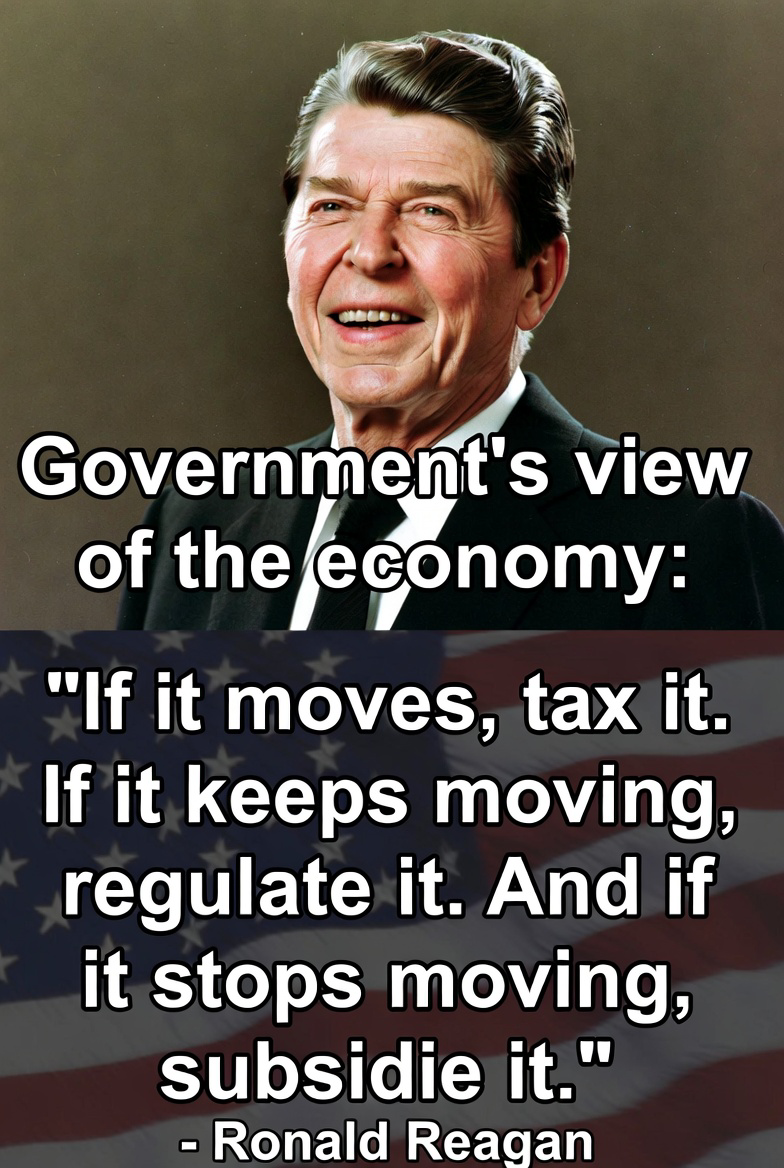
For decades, U.S. conservative economic philosophy has emphasized the primacy of free markets, arguing that government interference in private pricing distorts supply and demand, harms competition, and risks sliding toward centralized economic control (Friedman). Conservative rhetoric since the mid‑20th century has consistently framed price controls, mandated cost reductions, and state pressure on private businesses as hallmarks of socialism or communism (Hayek). Within this framework, the government’s role is to ensure market freedom, not to dictate or influence prices. This ideological stance has been central to Republican critiques of democratic socialism, which conservatives often portray as a threat to market autonomy.
Trump’s demand to gas stations therefore stands in tension with this traditional conservative position. While not a formal policy, the public pressure exerted by the president on private retailers to adjust prices aligns more closely with interventionist economic behavior than with free‑market orthodoxy.
Does Trump’s Demand Resemble Democratic Socialist Practice?
In one narrow respect, Trump’s demand resembles a tactic commonly associated with democratic socialist politics: public pressure on private businesses to lower prices for the sake of consumer welfare.

Democratic socialists frequently advocate moral and political campaigns urging corporations to reduce costs, increase wages, or alter business practices (Democratic Socialists of America). These campaigns often frame economic justice as a collective responsibility and encourage government officials to speak out against perceived corporate excess.
However, democratic socialist practice typically extends beyond rhetorical pressure. It is usually accompanied by legislative proposals, regulatory frameworks, or structural reforms aimed at reshaping market dynamics (Gindin and Panitch). Trump’s demand did not include any such policy mechanisms. It was a public exhortation rather than a regulatory initiative. Thus, while the action superficially resembles democratic socialist pressure campaigns, it does not reflect the deeper institutional or ideological commitments of democratic socialism.
Does This Resemble Communist Practice?
Communist economic systems historically rely on state ownership of the means of production, mandatory price controls, central planning, and compulsory compliance enforced by the state (Marx; Lenin). Under communism, fuel distribution, pricing, and supply chains are typically controlled by the government, and private retail markets do not exist in the conventional sense.
Trump’s demand does not resemble communist practice in any structural way. There was no state ownership, no legal mandate, no enforcement mechanism, and no central planning directive. The demand was rhetorical rather than coercive. It did not alter the ownership or governance of the fuel market. Therefore, while the demand involved presidential pressure on private pricing, it does not align with communist economic behavior.

Does Democratic Socialism’s Stance on Price Pressure Resemble Communism?
Democratic socialism and communism share one superficial similarity: both accept that the state has a legitimate role in shaping economic outcomes. This shared belief can manifest in support for price interventions, public pressure campaigns, or moral appeals to businesses. In this limited sense, democratic socialism’s stance on price pressure resembles communism’s acceptance of state involvement in markets.
However, the resemblance ends at this surface level. Democratic socialism is reformist, pluralistic, and democratic. It retains private ownership, maintains market mechanisms, and seeks to regulate rather than abolish capitalism (Schwartz). Communism, by contrast, is revolutionary, abolitionist, and centrally planned. It eliminates private ownership, replaces markets with state planning, and seeks a classless, stateless society (Marx; Lenin).
Thus, while both ideologies may support price interventions, the underlying structures, goals, and methods are fundamentally different. Democratic socialism’s stance on price pressure resembles communism only in the broad sense that both reject pure laissez‑faire economics.
What It Actually Resembles: Populist Economic Nationalism
Trump’s demand aligns most closely with a pattern observed in global populist economic nationalism. Populist leaders frequently pressure private companies to lower prices as a symbolic gesture of solidarity with “the people.” This tactic is common in countries such as India, Mexico, Hungary, and Argentina, where leaders publicly confront corporations to demonstrate responsiveness to public frustration over rising costs (Mudde; de la Torre).
Populist economic nationalism does not seek to restructure markets or impose ideological economic systems. Instead, it uses public rhetoric to position the leader as a defender of ordinary citizens against perceived corporate exploitation. Trump’s demand fits this model: a public appeal designed to signal advocacy for consumers without implementing formal economic controls.
So Does Trump’s Action Conflict with the Free‑Market vs. Controlled‑Economy Argument?
Yes. Trump’s demand conflicts with the traditional conservative argument that markets should operate without government interference. By urging private gas stations to lower prices, the president engaged in a form of state pressure that conservatives have historically criticized as “socialist” when proposed by political opponents (Friedman; Hayek). Although the demand lacked legal force, it nonetheless represented a departure from free‑market orthodoxy and aligned more closely with interventionist rhetoric.
This contradiction highlights a broader tension within contemporary conservative politics: the coexistence of free‑market ideology with populist economic messaging that occasionally embraces interventionist tactics.
And Yes — It Is Harmful to Small Gas Stations
Small, independently owned gas stations are disproportionately harmed by demands to lower prices immediately. These stations operate on razor‑thin margins, often earning only a few cents per gallon. Because they are still selling fuel refined from high‑cost crude purchased during the Hormuz crisis, lowering prices prematurely would force them to sell below cost (U.S. Energy Information Administration). Unlike large corporate chains, small stations cannot absorb such losses. They lack diversified revenue streams, bargaining power with distributors, and financial buffers.
As a result, premature price reductions could lead to financial strain, temporary closures, or even permanent shutdowns. Trump’s demand, while politically symbolic, carries real economic consequences for small retailers who cannot adjust prices until cheaper inventory arrives.
Works Cited
de la Torre, Carlos. Populist Seduction in Latin America. Ohio University Press, 2010.
Democratic Socialists of America. “What Is Democratic Socialism?” DSA, www.dsausa.org/about-us/what-is-democratic-socialism/ (dsausa.org in Bing).
Fox Business. “Trump Demands Gas Stations Lower Pump Prices Immediately.” Fox Business, 2026.
Friedman, Milton. Capitalism and Freedom. University of Chicago Press, 1962.
Gindin, Sam, and Leo Panitch. The Socialist Challenge Today. Monthly Review Press, 2018.
Hayek, Friedrich A. The Road to Serfdom. University of Chicago Press, 1944.
Lenin, Vladimir. The State and Revolution. 1917.
Marx, Karl. Critique of the Gotha Program. 1875.
Mudde, Cas. Populism: A Very Short Introduction. Oxford University Press, 2017.
Schwartz, Joseph. “Democratic Socialism and Economic Democracy.” Socialism and Democracy, vol. 28, no. 1, 2014.
U.S. Energy Information Administration. “Weekly Retail Gasoline and Diesel Prices.” EIA, www.eia.gov/petroleum/gasdiesel/.
Additional supporting reports


Comments